Background
David and Jayne Conn robotically milk 100 cows along with their four children at Ardina farm, close to Castlerock in Co Londonderry. This is a new business, established on a green field site just three years ago. The Ardina herd is currently averaging 10,500L on a rolling basis at 4.5% fat and 3.55% protein.
David explained: “There is scope to expand milking cow numbers up to 120 given the availability of the two robots, and our year-round calving pattern. We have used sexed semen quite widely on the cows, giving us the opportunity to select the extra heifers that we need. Our priority has been to breed herd replacements with the ability to improve milk components while, at the same time, having good legs and feet, together with health traits. It all adds up to functional cows that will remain in the herd for a long number of lactations.”
Objectives
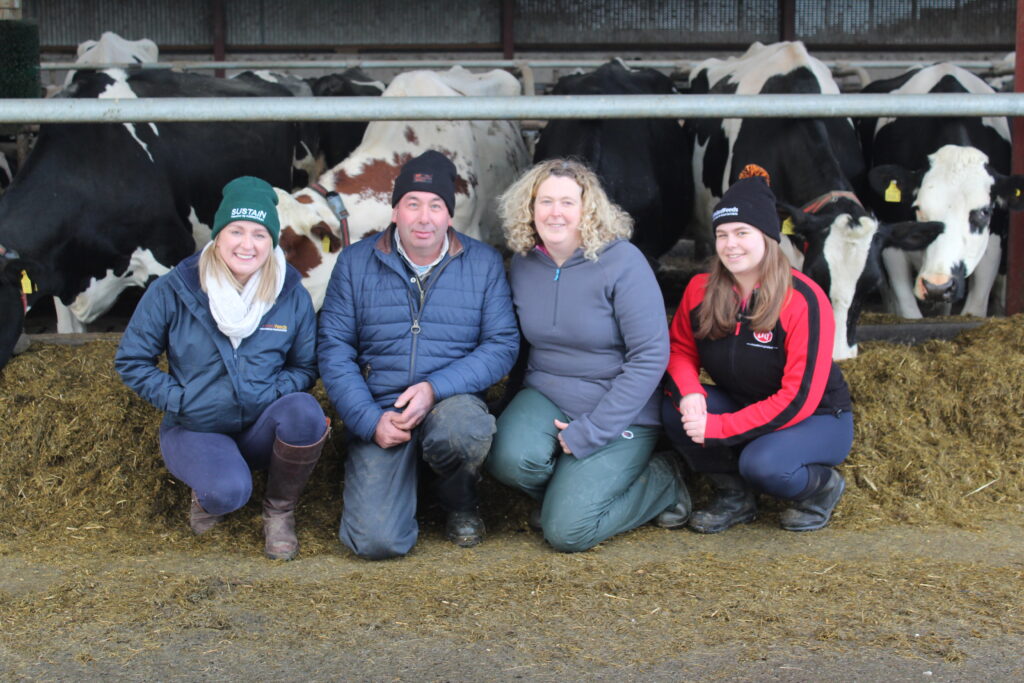
Edel Madden is the Conn’s nutritional adviser. “When we began working with David and Jayne they had clear goals in mind; To increase milk quality, while maintaining yield and fertility, and to improve forage intakes. We’ll talk through our strategy and how far we’ve progressed in this article.”
Current diet
Edel explains that “We have been working on ways to increase dry matter intakes from forages, since the farm was established. I’m pleased the current figure is at 12kg of dry matter per day. This has improved from below 10kg, through a combination of silage quality improvements and feed availability. Last year four cuts of silage were taken. First cut analysed at 28% DM, 11.5ME, 48NDF & 14.5% CP. It’s our role at United Feeds to recommend the best feeding strategy that fully complements the available forages and optimises cow performance.
Edel continues “Concentrates are fed by way of a basal TMR with nuts available through the robot on a feed to yield basis. The current TMR contains 4kg per cow of a customised blend, which is formulated to balance the forages fed. We include a rumen protected fat in both the blend and nut. This is to aid fatty acid production to support both milk quality and fertility. Protected fats can aid fertility in several ways; from supporting hormone production, to egg quality and body condition; all ultimately aiding conception rates.
We are currently feeding Supergold 17 through the robot. This nut contains our HerdCare supplement which is unique in the Northern Irish market as is contains 100% organic Selenium, Zinc, Copper and Manganese. These have been proven to aid in fertility through supporting uterine health, enhancing embryo survival and therefore conception rates.
Liquid glycol is fed during early lactation through the robot. Propylene glycol is not only another energy source, but increases blood insulin and progesterone levels, hence improving heats and conception rates.
Mycotoxins
We identified a mycotoxin issue, which is common in many of 2025 forages. Following the inclusion of Mycosorb A+ in the blend, David witnessed improvements in milk yield, dung consistency, and stabilised intakes, which were previously fluctuating. Mycosorb A+ is a broad-spectrum mycotoxin binder, helping mitigate the risks of mycotoxins by the method of adsorption. Adsorption is the process by which carbohydrate components of yeast and algae cell walls bind to mycotoxins, removing them from the animal’s digestive tract, while avoiding interactions with other minerals and nutrients.
Fertility focus
David explains, “A technician service is used to inseminate cows and heifers. There is no sweeper bull used. Sexed semen is used to source herd replacements and beef straws are used on all other occasions.
The average age at calving our heifers is 24 months. We are currently using 1.9 straws per pregnancy with 91% of cows are back in calf within 100 days of calving. The current calving interval is 393 days”.
Milk quality
Edel concludes, “As one of the Conn’s main objectives, it’s really pleasing to see progress. Taking the most recent month of February for comparison, from 2024 to 2026 butterfat has risen 17 points, protein has risen 18 points, all while maintaining yield.
Since starting their dairy enterprise David and Jayne have taken on board our recommendations and challenged us to help them achieve their goals. The production figures and the cows are testament to their commitment to run a successful, healthy herd.”
If you would like to discuss the fertility or production performance of your herd, contact your local nutritional adviser or call 028 9075 9000.