The use of a tailored total mixed ration (TMR) is helping drive the levels of cow performance achieved by Richard Coalter and his father Alan on the family’s dairy farm, near Ballinamallard, Co Fermanagh. Herd performance is currently averaging 9,050L on a rolling basis at 4.68% butterfat and 3.8% protein on twice a day milking.
Richard explains, “We are currently milking 70 Friesian cows, calving from the beginning of September through to February, however we are aiming to reduce this to a 10-week block and have calving concluding by Christmas. Our overall aim for our herd is to utilise forage for milk as much as possible”.
Richard continues “We set out to make good quality silage while giving the cows access to as much high-quality grass as we can produce from mid-March onwards on a 40-acre grazing block beside our silage ground around the yard. By committing to an autumn calving season, the cows can be maintained on a consistent and high plane of nutrition during their early lactation when housed, meaning they’re all back in calf and in good style at turnout. We graze day and night with concentrates fed via a feed to yield system in the parlour. Our maiden heifers and youngstock are also grazed fulltime, with the maidens in calf before turnout and calving down at 24 months old in September/October each year. We are achieving our current level of performance from an average concentrate feed rate of just under 2.8T per cow. Our current objective for our herd is to further increase cow output to 9,500L per head whilst maintaining the current high levels of milk quality and further improve fertility on this level of concentrate fed or less”.
Up to four cuts of silage are made on the Coalter farm each year. Three cuts are destined for the pit with the fourth baled. As well as this, 16 acres of conacre is baled for dry cow silage. These bales have proven vital for sound transition management with fresh cows entering the milking herd with no issues during or post-calving and excellent colostrum production. Wholecrop wheat was also grown as a winter forage source for the first time in the 2025, which was a great success, further increasing dry matter intakes and performance.
Clive Morrison from United Feeds is the Coalter’s nutritional adviser, with support from Ruminant Nutritionist, Megan Morrow.
“All the silages, including the whole crop, are layered up equally within the one pit. This means that the cows are receiving a consistent mix of forages throughout the feeding season,” Clive confirmed.
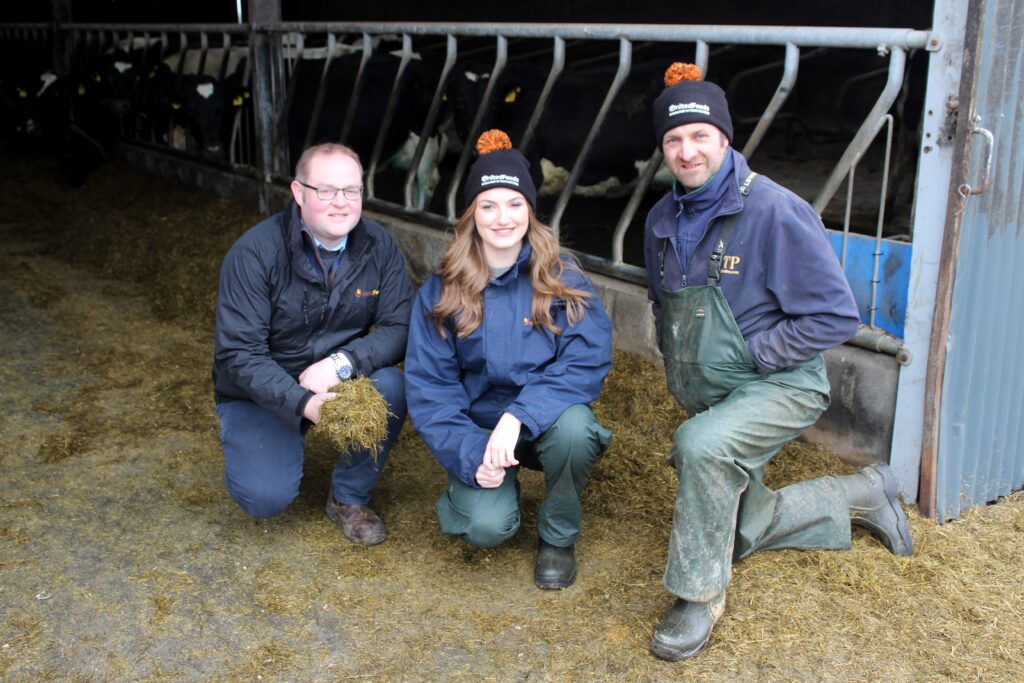
Clive Morrison, Megan Morrow and Richard Coulter
Megan explains “all three cuts of silage were very similar this year, with dry matters averaging in the region of 28-30%, ME ranging from 11.5-12 and NDF ranging from 45.6-49.6%. Based on the forage analysis and Richard’s objectives for the herd, I formulated a blend for the TMR. Currently it is 18% protein. We then top up in the parlour with a Parlour Cream 18 nut using feed to yield. The TMR is maintenance + 26.5 litres; comprising of 6kg of a bespoke blend and 14.2kg forage dry matter intake.
The customised dairy blend contains a number of selected additives to help us achieve Richard’s goals; rumen protected fat, Equaliser, Yea-sacc, Mycosorb and our unique HerdCare supplement. All added with enhancing production and fertility in mind. The combination of C18 & C16 protected fats is used to aid fatty acid production which will support milk quality, yield and fertility. Our HerdCare supplement is unique to the Northern Irish market and contains 100% organic Selenium, Zinc, Copper and Manganese. These have been proven to aid with fertility, somatic cell counts, hoof health and milk production. Yea-Sacc aids in maintaining a stable environment within the rumen, optimising feed utilisation. Mycosorb and Equaliser were added as precautionary measures as Richard had some mycotoxin issues in previous years and wanted to make sure all bases were covered, particularly with this being his first year feeding wholecrop wheat.”
Richard is very focused on grass utilisation and is keen to get cows out to graze as soon as weather conditions permit. Once the cows are out day and night, blend feeding will cease. As the parlour nut is then the sole concentrate feed source, we will switch to the Cream Maker dairy nut range. The Cream Maker range contains many of the elements in the current diet; high levels of protected fat, Yea-Sacc yeast and HerdCare supplement. Cream Maker is chosen specifically to help support butterfat production on a grass only system. A ‘rumen friendly’ ration for a twice a day feeding at high levels, helping support the energy levels of Richard’s high production cows while maintaining healthy rumen function.
Megan continues, “It is encouraging to hear that fertility within the Coalter’s herd has been particularly strong this year. We often spend more time analysing situations when something hasn’t gone well, but it’s equally important to do so when it has. On reflection we think this year’s success can be attributed to several factors. Firstly, improving transition cow management onto the current diet, which has been fed consistently from 1st October when cows came in off grass full-time, led to strong heats and stable body condition scores throughout early lactation and the breeding period. This combined with the use of Sensehub collars meant Richard achieved phenomenal conception rates with 99% of maiden heifers and 65% of the milking herd all due to calf within the first 8 weeks of calving, due to commence September 2026. Richard was able to achieve this with just 1.6 straws used per pregnancy. This is a huge step forward to his desired 10-week calving block and remains on target to further improve his current average 361-day calving index.”
Richard Coalter concludes, ““We operate a very strict breeding policy. The cows receive sexed semen for six weeks. After that, we switch to beef bulls. There are always plenty of heifers coming through, leaving us the option to sell cows that do not meet our breeding target. We select these cows by analysing feet, last 12-month production performance and their individual SCC which we can easily measure as we conduct milk recording every 6 weeks, all year round. This ensures that we can continue to achieve and increase milk quality bonuses, whilst maintaining the standard we have developed within our herd. Although fertility has been a great success this year and I’m pleased our calving index is currently sitting at 361 days, we are continually looking at ways of implementing new recommendations and guidance to keep improving our performance and herd development plan. We are working very closely with Clive and Megan from United Feeds to further increase milk production, improve fertility and manage our concentrate feed levels as the year continues.”
If you would like to discuss driving the dairy performance of your herd, contact your local nutritional adviser or call 028 9075 9000.