Farms across Northern Ireland are acutely aware of the value of the nutrients in animal slurry and the importance of a healthy soil structure and biology. Digest-it® microbial slurry inoculant is helping farmers to make significant improvements in both these areas.
Through the treatment of their slurry with Digest-it, farms across Northern Ireland are increasing the nutrient value of their animal slurry in tandem with having a positive impact on soil structure and biology.
Nine years of research
Moreover, the impact of the product has been fully quantified and endorsed on the back of nine years’ trial work and this commitment to assess the impact of Digest-it® continues apace.
At a fundamental level, the inoculant works to reduce the amount of mixing required prior to slurries being spread on land.
This effect is achieved by placing Digest-it® into the bottom of an almost empty below ground slurry tank or above ground slurry tank.
Over the ensuing weeks, the microbes within the product will act to produce a homogenous slurry suspension that requires significantly less agitation prior to spreading. This process also acts to reduce the smells associated with the mixing of slurries.
But as is often the case, the biological effect of microbes can have many facets. And this is very much the case, where Digest-it® is concerned.
The microbes within the inoculant use the slurry as a nutritional source, allowing them to build up population numbers.
As part of this process the ammonia released within the tank on a continuous base is taken up by the microorganisms and used within their metabolic pathways.
In turn this leads to significantly reduced ammonia emission levels. However, in an addition, the nitrogen taken up by the microbes in the tank will be used as an additional nitrogen source once the Digest-it® treated slurry has been spread onto land.
The action of the microbes within the inoculant will also ensure that soil organic matter and biology levels are enhanced post-spreading. In turn, this will act to significantly improve soil structure.
So, we are looking at a win: win situation, one that improves the economic value of animal slurry while, at the same time, reducing their environmental footprint.
Year nine of the ongoing Digest-it® research trials, focussed on both grazing and silage scenarios and quantifies the latest benefits that the slurry inoculant will deliver.
Significantly, the work confirms that the inoculant has consistently delivered an additional grass dry matter yield more than 1.0t dry matter per hectare.
The average figure recorded during the period 2017 to 2025 is 1.2t/ha. This works out at +19% relative to trial plots.
This extra dry matter yield is worth an additional £190 or a return on investment of 14: 1.
New for 2025 is the confirmation that Digest-it® treated slurries have nitrogen utilisation efficiency (NUE) values that are 69% higher than those recorded in scenarios where untreated slurry was used.
In other words, Digest-it® is delivering an additional 62kg of nitrogen/ha.
Soil analysis results have consistently shown that Digest-it® acts to improve soil organic matters and active carbon levels by 32% and 35%, respectively.
Trial work has also confirmed a 29% reduction in free nitrate levels within Digest-it® treated slurries.
United Feeds
The Digest-it® research trials have been undertaken by Devenish Nutrition. The product is available in Northern Ireland from United Feeds.
Making optimal use of slurry has never been more important for all farming businesses. In most cases, it represents a home-produced resource that can be used to enhance grass and crop outputs.
Meanwhile, the effective use of slurry can help to secure the all-important sustainability targets that must be achieved across agriculture.
Slurry is a valuable source of plant nutrients, including nitrogen (N) phosphate (P) and potash (K). But unlike chemical fertiliser, it is a biological resource.
This means that the crop nutrients within slurry, particularly N, are both in a slow-release organic mineralised form and quick release plant available form, which is subject to volatile losses such as ammonia and leaching. Reducing these losses will improve the fertiliser value of slurry.
Soil biology
It is now recognised that three factors combine to maximise the effectiveness of soils to grow high quality crops. These are: soil structure, soil chemistry and soil biology.
United Feeds’ agronomist, Chloe Kyle, takes up that story:
“Digest-it® impacts positively on every aspect of soil health.”
“Driving all of this is the ability of treated slurry to enhance soil earthworm numbers.”
“This is at the very heart of achieving greater sustainability on farms.”
“Earthworms act to improve soil structure. Their burrowing activities are key to improving aggregate formation within a soil profile.”
She continued:
“As farmers face-up to the challenge of lowering the carbon footprint of their enterprises and becoming more sustainable, they must seek to identify ways of maximising the resources generated within their businesses.”
“Making best use of animal slurry is critically important in this context. It is an approach that will allow farmers to grow more grass or produce the same amount of with a reduced dependency on chemical fertilisers.”
She continued
“Digest-it® will allow farmers achieve one or other of these objectives in a very meaningful manner.”
Mixing slurry
Depending on the tank design, the time required to mix Digest-it® treated slurry below slats thoroughly can be reduced by up to 50%.
However, it is important that the inoculant is applied when a tank is low, usually at the start of winter and is subsequently allowed to inoculate the slurry for up to 16 weeks.
Evidence of this mixing activity is evident from the bubbles that percolate through the slurry during this period.
“Digest-it® is exceptionally good at breaking down sludge that accumulates at the bottom of tanks.”
This, in turn, is putting additional P and K into solution. These nutrients are not volatile and, as a result, will be plant available once the treated slurry is spread onto grassland and or crops.
The farmer experience
Andrew Dale milks 135 cross bred cows with his father Jackie close to Limavady. The herd comprises a mix of Viking Red, Viking Holstein Red and Jersey bloodlines. It has a strong autumn calving focus.
“The cows are currently averaging 7,500L of milk at 4.9% butterfat and 3.7% protein. Our aim is to break through the 5% butterfat threshold over the coming months,” Andrew commented.
“We take three cuts of grass silage annually. This is complemented with home grown whole crop wheat.”
He added:
“Barley is also grown as a cereal crop. The straw comes in very useful; both form a feeding and bedding perspective.”
There are several slurry tanks on the Dale’s farm, including an aboveground slurry store. This will be the third year that Andrew has treated the slurries produced on the farm with Digest-it®.
Andrew further explained:
“We plan to empty all the tanks on the farm prior to the October 15th spreading ban.”
“After that I will place the required volume of Digest-it® into the tank below the heifer house. Some of this will then be transferred to the aboveground store, thereby inoculating the slurry coming from the main cow shed.”
“When it comes to spreading slurry on the farm, a local contractor with an umbilical system is used in the springtime.”
“We can then cover the rest with our own tankers. Most of the slurry is put onto silage ground.”
Andrew is keen to maximise the value of the slurry available to him. He also wants access to the slurry in a way that reduces the amount of agitation and mixing required.
“The less time required to mix the tanks obviously saves time: it also minimises the stress on the cattle when all of this activity is taking place,” he commented.
“The objective in using Digest-it® was to reduce the time required to mix slurry in the spring,” he explained.”
“And it works tremendously well in meeting this requirement.”
“Over the past two years, I have found that adding the product to the tanks at the start of the winter feeding significantly reduces the agitation time required the following spring.”
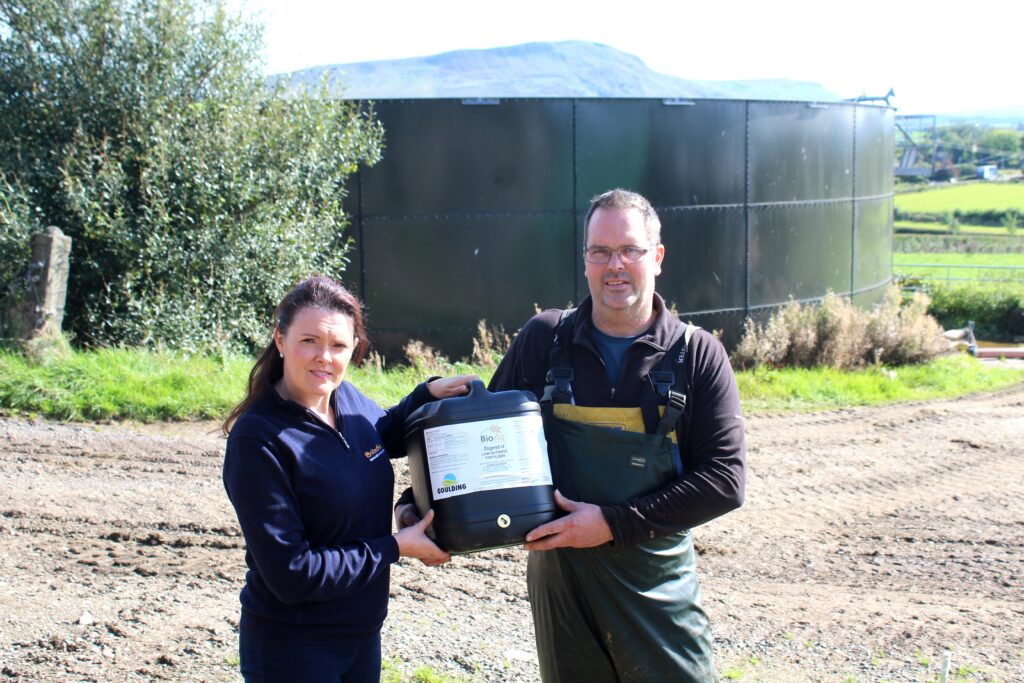
Andrew continued:
“I have also noticed that there is much less smell associated with slurries treated with Digest-it®.Bottom line: the product works, and I am using it again for the third season.”
“There is also ample evidence on the farm to confirm the fertiliser boost that Digest-it® delivers.”
“I recently walked through a field that had been cut three times for silage this year. The sward received Digest-it® treated slurry in the spring but no chemical fertiliser since the last cut of silage was taken.”
“The amount of available grass available on that field right now is more than impressive.”
“We have also found that the inoculated slurry comes out of the tank with a uniform consistency.”
“This means there is no build-up of slurry solids on the grass, if a dry spell comes in after spreading. The last thing we need is contaminated forage coming back into the silage pits.”
In conclusion
The potential of animal slurries as powerful soil conditioners, while also delivering important nutrients to crops, has long been recognised.
However, it has taken years of research and development in the field of microbiology to convert all this potential into true reality.
Digest-it® embodies all this work. Significantly, demand for the product continues to grow on farms across Northern Ireland.
Chloe Kyle again:
“Farmers know they must make best use of the resources they have available to them within their own businesses.”
“Securing improved levels of sustainability, in every sense, is at the heart of all modern farming systems.”
“And enhanced slurry utilisation leads the way in this regard. Digest-it® has been specifically developed to make this a reality.”
“Sales of the product have grown strongly over the past number of years. And we fully expect this trend to be maintained during the period ahead.”
Digest-it® comes in 20L drums: one drum will treat 100,000 gallons of slurry. It takes 16 weeks for the slurry additive to generate its full effect; therefore the sooner it is added to slurry tanks the better.
For more information, please call contact your local United Feeds sales representative, phone the office 02890 759000 or email sales@ufeeds.com.