Committing to a predominantly autumn/winter calving season offers a number of distinct benefits for Co Londonderry father and son dairy farming team: John and Jonathan Kyle.
In the first instance, it allows them to avail of the winter milk bonuses available from Dale Farm. However, it also ensures they can make best use of their time, in terms of both milking the cows and rearing calves.
Preparations for the calving season ahead kicks off in the early summer with an assessment of Body Condition Scores (BCS) across the entire milking group.
“We want the cows to be calving down with a BCS of around 3.0,” Jonathan explained.
“Cows that are that little bit thinner will receive extra meal in the run-up to drying off.”
The Kyles farm close to the village of Culnady. Their herd comprises 160 cows, currently averaging 9,500L at 4.2% butterfat and 3.3% protein.
The calving season on the Kyle farm starts in September.
“The heifers calve first. The aim is to bring our home-bred replacements into the milking group at 24 months,” Jonathan explained.
“We use sexed seen to get the replacements that we need. After that we switch to beef straws.
Both John and Jonathan are trained inseminators. Last year an average of 1.7 straws were used per calf born on the farm.
All breeding animals are internally checked for issues such as metritis, prior to the start of the breeding season.
Jonathan continued:
“Dry cow management is critically important. And we do everything to ensure that the cows are provided with the best possible management in the run-up to calving.
“The cows are dried off two months before their calving date. This year we plan to vaccinate them for rotavirus at this stage.”
Those cows dried off in the late summer/early autumn period are put out to a rough grazing area for four weeks.
They are housed four weeks prior to calving, at which stage they are put on a bespoke dry cow ration.
Jonathan commented:
“At this stage the animals are fed a TMR comprising of dry cow silage, made specifically as bales on the farm, United Feeds’ pre-calver blend and wheat straw.
“The dry cow silage is made from swards that have received no slurry.”
John Kelso commented on the impact this approach to dry cow nutrition is having on the herd:
“We have been using the United Feeds pre-calver blend for the past seven years. And it has worked well for us.
“We never have issued with metabolic problems after calving and the calves are born with lots of vitality.
“The only issue that we might have at calving is the odd cows carrying twins.”
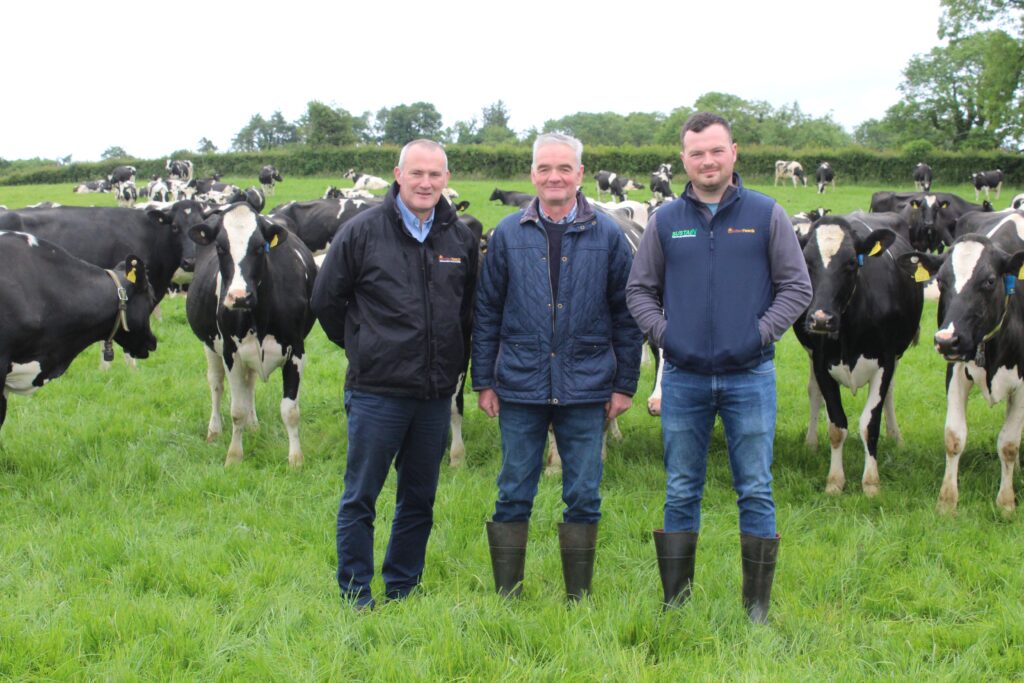
United Feeds Martin Clarke is the Kyle’s nutritional adviser. “The pre-calver ration is available in bulk either as blend or nuts, and in bags only as nuts,” he explained.
“Blends suit those farmers feeding a TMR. But it’s a feeding option that also allows specification changes to be made, to fully complement both the mineral and nutritional content of the dry cow forages available on individual farms.”
He continued:
“Demand for the pre-calver ration continues to grow.”
Meanwhile, the overall specification of the United Feeds’ pre-calver ration is continuously reviewed with the sole objective of enhancing its nutritional impact.
A case in point has been the recent, standard inclusion of a uniquely effective Vitamin D source: Hy-D®.
The additive works to deliver an immediate supply of Vitamin D for both cows and calves.
Global studies involving thousands of dairy cows across the USA and Europe, including the UK and Ireland show may dairy cows have a poor vitamin D status, and are particularly insufficient at the time of calving.
Vitamin D is crucial in calcium and phosphorus regulation. It is required in the kidneys, intestine and in the bone to stimulate both calcium mobilisation and absorption, along with phosphorus absorption.
Supplementing cows with Hy-D® versus a more standard form vitamin D3 significantly increased serum vitamin D levels. This has been proven to offer numerous benefits; from increased milk yield in early lactation, reduced postpartum clinical diseases, (independent of DCAD), including metritis and retained placentas, and improvements in both colostrum quality and quantity.
For assistance with your dry cow’s diet please contact your local ruminant nutrition adviser, call 02890 75900 or visit www.ufeeds.com.